
Table of Contents
ToggleThe Actor’s Paradox: When the Stage Feels Safer Than Real Life
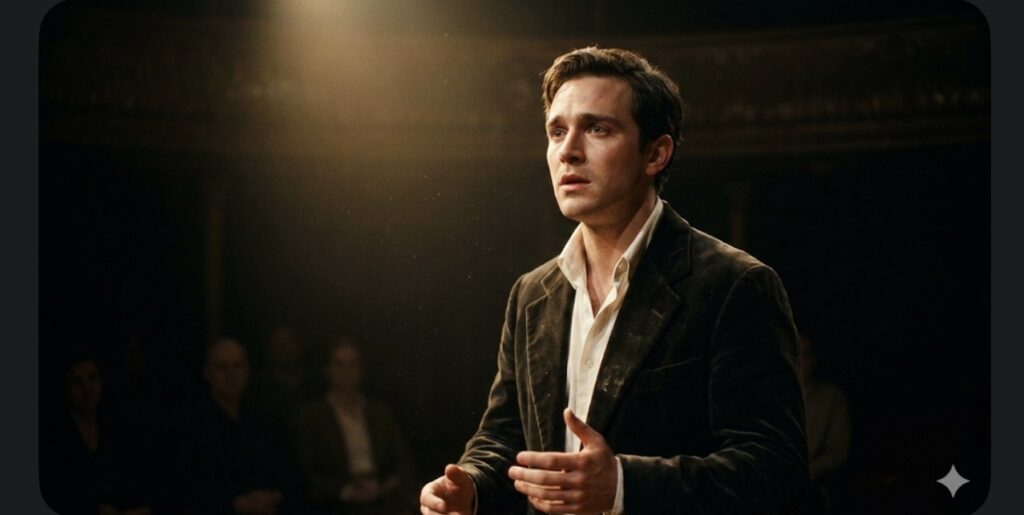
Have you ever wondered why someone who appears completely at ease under the lights may feel intensely shy, self-conscious, or socially anxious in everyday life?
It sounds contradictory.
An actor may stand in front of hundreds of people, inhabit another person’s emotions, sing, speak, move and command attention—and then find an ordinary conversation with a stranger unexpectedly difficult.
This is what I call the actor’s paradox.
The stage can sometimes feel safer than everyday life precisely because it is structured. There is a script. There are rehearsed movements. There is a beginning, a middle and an end. The performer knows what is expected.
Everyday social interaction offers none of these guarantees.
For performers who experience social or performance anxiety, this distinction can be profoundly important. Research on social anxiety has consistently identified heightened self-focused attention and post-event rumination as important features of social and performance anxiety.
Perhaps the stage is not always the place where anxiety disappears.
Perhaps it is the place where anxiety finally has somewhere to go.
Why the Stage Can Feel Safer
Imagine being asked to walk into a room full of strangers and simply “be yourself.”
What does that mean?
What should you say?
How should you stand?
What should you do with your hands?
Are people judging you?
Did you say the wrong thing?
For someone who is highly self-conscious, the number of possible choices can become overwhelming.
Now replace that situation with a theatrical performance.
You have a script.
You know where to stand.
You know when to speak.
You know what the other character is going to say.
You know what happens next.
The structure itself can become containing.
1. A Managed Task
Instead of asking:
“What should I do?”
the performer can ask:
“What does my character need to do here?”
That small shift can move attention away from constant self-monitoring and towards the task.
The performer is no longer required to invent themselves moment by moment.
They have something to do.
2. A Cognitive Framework
Blocking, text, music, choreography and rehearsal create a framework within which the performer can operate.
This does not necessarily eliminate anxiety. Instead, it gives the nervous system something specific to organise around.
For a singer in Music Theatre, this can be particularly powerful.
The words, melody, rhythm, movement and dramatic circumstances all provide information about what happens next.
The performer does not have to solve the entire social situation.
They simply have to inhabit the moment.
3. A Different Relationship with Attention
Social anxiety often involves turning attention inward:
How am I doing?
How do I look?
Does my voice sound strange?
Did they notice that mistake?
Research has linked self-focused attention with social and performance anxiety, while post-event processing can continue after the interaction or performance has ended.
Theatre offers another possibility.
Instead of watching yourself, you can watch the character.
Instead of asking “How am I performing?”, you can ask:
“What am I trying to accomplish?”
That is a very different kind of attention.
The Actor’s Relationship with Emotion
Actors are often described as people who “become” their characters.
But good acting is not simply about becoming overwhelmed by emotion.
It requires the performer to develop a relationship with emotion.
An actor may experience fear without becoming the fear.
They may portray grief without being consumed by grief.
They may play anger while remaining sufficiently aware to speak the next line, respond to the other actor and remain connected to the story.
This distinction is valuable far beyond the theatre.
An emotion is something we experience. It is not the entirety of who we are.
Fear can be present without defining us.
Embarrassment can be present without becoming our identity.
Anxiety can be present without determining what we do next.
For performers, this is one of the most important skills the stage can teach.
From Self-Consciousness to Character Consciousness
When anxiety becomes intense, attention can collapse inward.
The performer starts monitoring themselves:
Am I shaking?
Can they hear my breathing?
Was that note good enough?
What are they thinking about me?
This can create a feedback loop in which the performer becomes increasingly aware of their own physical sensations and increasingly concerned about how those sensations appear to others.
But character work offers another direction.
Instead of:
“What are they thinking about me?”
try:
“What does my character want?”
Instead of:
“Am I doing this correctly?”
try:
“What is happening to this character right now?”
Instead of:
“How do I look?”
try:
“What am I trying to communicate?”
The attention moves from self-surveillance to purposeful action.
That shift can be transformative.
The Character as a Safe Container
A role can sometimes give a performer permission to express something that feels difficult to express personally.
A character can be angry.
A character can be vulnerable.
A character can cry.
A character can demand attention.
A character can say:
“I love you.”
“I’m afraid.”
“Leave me alone.”
“I need you.”
The performer may discover that these emotions are easier to approach when they belong, initially, to someone else.
This does not mean that acting is necessarily a form of dissociation.
Rather, the role creates psychological boundaries.
There is a distinction between:
“I am experiencing this emotion as myself”
and
“I am exploring this emotion through this character, within this story, at this particular moment.”
That distinction can provide both freedom and containment.
And sometimes, something unexpected happens.
The emotion that begins as the character’s becomes recognisable as the performer’s too.
Not because the performer has lost themselves.
But because the character has helped them discover another part of themselves.
The “Come Down” After Performance
Then the performance ends.
The lights come up.
The costume comes off.
The audience leaves.
The adrenaline of performance begins to settle.
And suddenly, there is silence.
For some performers, this transition can feel surprisingly uncomfortable.
After an intense period of concentration, movement, emotional engagement and social evaluation, returning to ordinary life can feel strangely abrupt.
There may also be a tendency to replay the performance afterwards:
Why did I do that?
Was that note flat?
Did everyone notice?
Why did I move like that?
This kind of post-event processing is well documented in social and performance anxiety.
The answer is not necessarily to analyse the performance more.
Sometimes the wiser response is to allow the performance to end.
The body has finished its work.
The character has been put down.
The story is over.
Now it is time to come home to yourself.
What the Stage Can Teach Us About Everyday Life
The most interesting lesson of the actor’s paradox is not that socially anxious people should hide behind characters.
It is the opposite.
The stage can become a laboratory for discovering capacities that already exist within us.
Perhaps the person who can speak confidently as a character can gradually discover that they are capable of speaking with confidence as themselves.
Perhaps the person who can make eye contact with an audience while playing a role can begin to tolerate being seen in ordinary conversation.
Perhaps the person who can express enormous emotion through a character can learn that their own emotions do not need to be feared.
The stage becomes a place to practise something larger than performance:
presence.
From Performance to Being
At Vocalogy, this is one reason we are interested in the relationship between voice, acting, music and the nervous system.
The voice does not exist separately from the person using it.
When a performer is frightened, the voice may change.
When attention becomes scattered, coordination may change.
When the performer feels safe enough to explore, something different may become possible.
This does not mean that voice training or acting can “cure” social anxiety. Social anxiety can be a significant mental health condition, and people experiencing persistent or impairing anxiety may benefit from working with an appropriately qualified mental-health professional.
But artistic practice can offer something valuable alongside appropriate support:
a place to experiment with being seen.
A place to practise attention.
A place to experience emotion without being consumed by it.
A place to discover that the body can feel fear and still act.
And perhaps, eventually, a place to discover that the person who feels powerful under the lights is not an entirely different person.
They are you.
The character did not create that capacity.
The character helped you find it.
The stage is not necessarily an escape from the self.
Sometimes, it is where we first learn how to come home to it.