
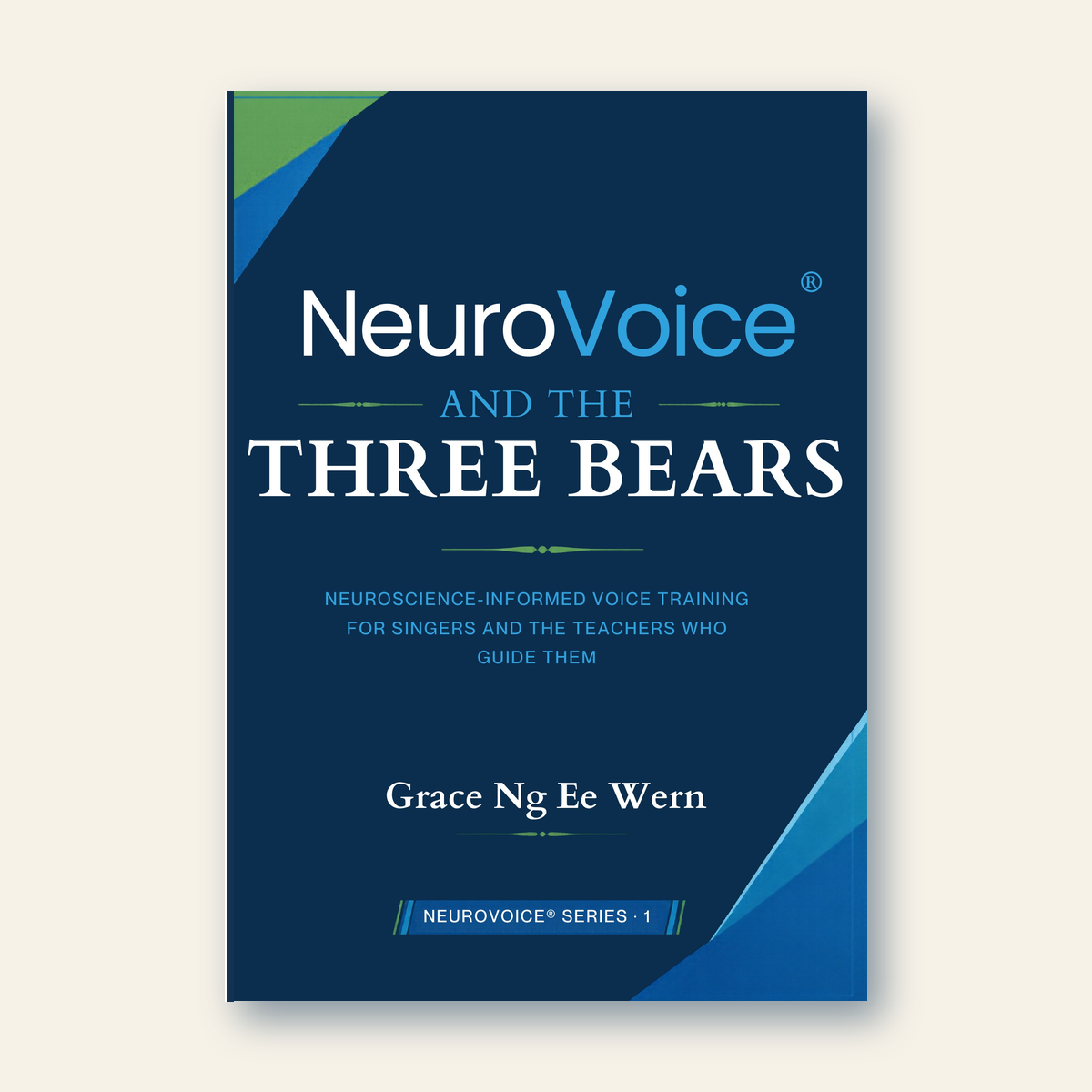
NeuroVoice® and the Three Bears (Ebook, PDF)
$4.99
The Same Old Note: Why your voice problem keeps coming back
You practised every day for three weeks. The phrase that always caught in your throat was finally getting easier. Then, one ordinary Tuesday, the old tightness was back, on the same word, in the same place.
You did the work. So why is it back?
Your voice belongs to a person, and that person runs on a brain. How you slept, how safe you feel, an old injury, a busy week at work: your brain reacts to all of it, and your voice follows. A voice exercise only talks to your voice. When the rest of you is pulling the other way, the old habit comes back.
Three Bears, One Voice: Find out which one is grumpy
Taking its cue from Goldilocks, the book gives you three brain functions behind your voice and tells you what each one looks like when it’s struggling:
- The doing brain (the Great, Huge Bear) runs movement, balance and timing. Rhythm and counting problems, or a tight jaw, tongue or throat? Start here.
- The thinking brain (the Middle-sized Bear) listens, plans and focuses. Can’t find the note, or out of tune without knowing it? Start here.
- The feeling brain (the Little, Small, Wee Bear) keeps asking, “Am I safe?” A note you dread, a voice that’s better at home, a mind that goes blank? Start here.
You’ll also meet the stress bucket. Danger drips in, safety lets water out, and when it overflows, you hear it in your voice.
Make Your Own Porridge: What you walk away with
Your own recipe. The STATE method (Spot, Test, Activate, Train, Evaluate) walks you through it: choose a short test phrase where your problem shows up, sing it, try one drill, then sing it again. Keep what helps. Drop what doesn’t, without guilt.
By the last page, you’ll know which bear to check first, which drills suit your voice, and how to tell a real change from a lucky day. You’ll also have a logbook to prove it.
Open It Tonight: What’s inside
- A “Start Here” map that takes you from your problem to the right page
- Seven chapters in three parts, told as a story
- A self-assessment to find which bear to start with
- A quick finder that matches problems to drills
- The full drill library
- A practice log, a reading list, a glossary and an index
- Free A4 printable pages to download from the website: your logbook, the Bucket Check and My Voice Weather Report
Read it front to back as a story, or go straight to the drills.
Names and Dates: What comes from research, and what comes from my studio
Research comes with the researchers’ names and the year, and every source is in the reading list so you can check it yourself. Studio stories come from real lessons, with names and details changed. The NeuroVoice® drills themselves haven’t yet been tested in published research, and the book says so plainly. Your test phrase is how you find out whether they work for you.
Two Kinds of Readers: Who it’s for
Singers training themselves, who want to understand why their voice behaves the way it does.
Voice teachers curious about the brain, looking for new ways in when the usual exercise stops working.
If you can follow a fairy tale, you can follow this book.
Stop Signs: A word on safety
This book teaches. Your doctor treats. NeuroVoice® is voice training. It doesn’t diagnose or treat any illness or injury. If your voice has been hoarse for more than three weeks, or singing hurts, please see an ENT doctor first.
Book details
- Author: Grace Ng Ee Wern, founder of Vocalogy
- Format: Ebook (PDF), 166 pages
- ISBN: 978-981-94-8530-7
- Published: 2026, NeuroVoice® series, book 1
- Delivery: download link after purchase
Priced low on purpose, so the ideas travel.
Rather work on it with a teacher? Book a first lesson at Vocalogy.
A voice problem that keeps coming back is telling you something about the rest of you. This book shows you how to read the message, using the three bears (your doing, thinking and feeling brain), one short test phrase and a five-step plan for good days and tired ones.
For singers training themselves, and for voice teachers curious about the brain. No science background needed.
Ebook (PDF) · 166 pages · S$4.99
How to use
Recording
Listen to the recording as and when required. Do not listen when driving, crossing the road or operating heavy machinery.
Text / Script
Read the text to yourself or others. You may read the text out loud or to yourself. It doesn’t matter. The effect will be the same.