
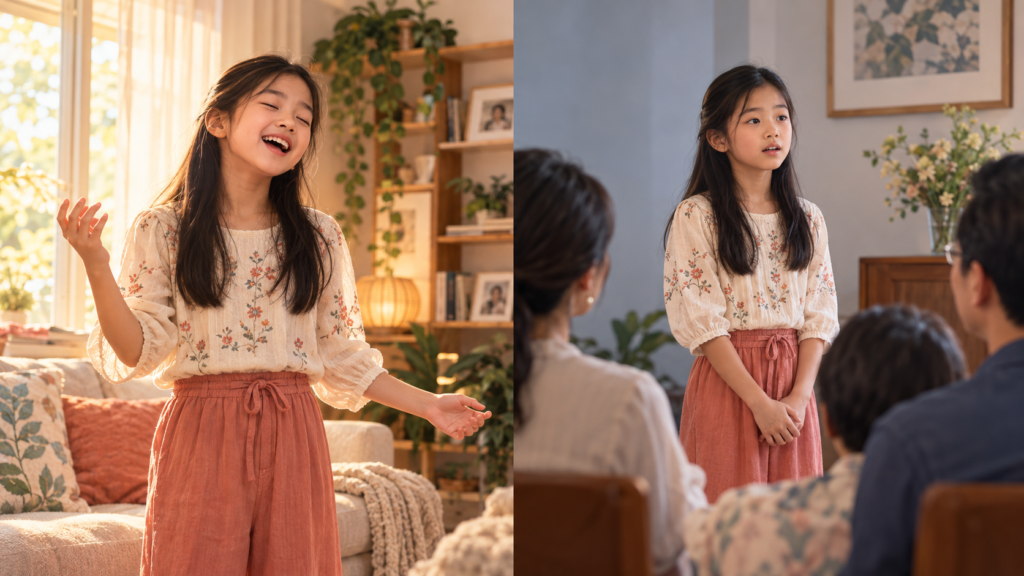
Your child sings the entire song at home. Then a relative asks, “Will you sing it for us?”
The voice drops to a whisper. Or your child says they have forgotten the words.
It is easy to wonder whether they need more confidence, more practice, or a push to get started. But first, compare what you are asking them to do. Were they singing along with the artist at home and expected to begin alone now? Is somebody watching closely or holding up a phone?
The song may be familiar. The task has changed.
Your child may know the music and possess the vocal skill, while the presence of a listener changes their attention, breathing, timing, volume, choices, or willingness to take a risk.
That does not automatically mean they have stage fright. It does not mean the talent you hear at home is imaginary either. Noticing which part changed gives you a more useful starting point than calling your child shy.
Table of Contents
ToggleWhy does my child sing confidently at home but not in front of people?
Home singing may be doing more of the work than anybody realises.
Your child knows the room. They can begin whenever they like, repeat the favourite part or stop when someone walks in. There may be no starting note or expectant silence.
They may also be singing with the original artist. That provides melody, rhythm, words, energy, and a voice to hide inside. Remove the recording, place one adult in front of the child, and ask them to begin alone, and several things have changed at once.
The song is the same. The task is not.
Sometimes the missing bridge is musical. The child is still learning to carry the tune independently, find the opening note, or remember the words without the recording.
Sometimes being heard changes the experience. The child begins watching faces for a reaction. They wonder whether the note is correct, whether the adult likes the sound, or whether the phone pointed in their direction is recording.
Often, several of these things overlap.
Is my child shy, nervous, or simply not ready?
“She’s shy” can feel like an explanation because it matches what we see.
But it may conceal several different experiences.
A child may be comfortable singing to one trusted teacher and silent in front of relatives. Another may happily perform in an ensemble but dislike singing alone. One child may want the audition very much and find it difficult to begin. Another may enjoy singing deeply and have no interest in turning that pleasure into a public event.
Even “nervous” can mean different things. The child may worry about forgetting the words, disappointing an adult, being laughed at, or being recorded and shared.
Before settling on a label, ask a more useful question:
What changed when listening became part of the task?
That question moves us from judging the child’s personality to observing their experience.
Is singing along at home the same as singing independently?
Not always.
When a child sings with a recording, they may be supported by:
- the original singer carrying the melody;
- lyrics on a screen;
- familiar timing and accompaniment;
- the freedom to move, play and join in selectively;
- repeated listening;
- no requirement to begin or finish alone.
This is real singing and real musical engagement. It can also disguise which parts of the task the child can yet manage independently.
Try lowering the recording for one familiar line. Can your child continue? Can they find the opening note without the artist? Does the rhythm remain steady when the guide disappears?
If not, the public difficulty may not be purely about confidence. Your child may still be developing the musical independence the performance requires.
This is similar to the distinction explored in How Long Do Singing Lessons Take to Work? A Parent’s Guide. Producing a skill under one supportive condition is an important beginning. Using it reliably when the conditions change takes further learning.
What changes when somebody starts listening?
Watch what happens before deciding why it happens.
You may notice that your child:
- holds or hurries the breath;
- becomes physically smaller or unusually rigid;
- sings much more softly;
- pushes for sudden volume;
- rushes the rhythm;
- loses words they knew a moment ago;
- watches the listener’s face instead of staying with the song;
- restarts repeatedly or apologises;
- refuses before making a sound;
- or becomes freer as soon as the formal request is withdrawn.
These are observations. None of them diagnoses anxiety, low self-esteem, or a problem with the nervous system.
They help us locate the first change.
Perhaps the child sings until the listener makes direct eye contact. Perhaps the words disappear only after a mistake. Perhaps the voice remains clear but so quiet that it no longer carries. Perhaps the difficulty begins before the singing, in the silence while everybody waits.
Recognition gives us somewhere to work.
Could fear of judgement or perfectionism be part of it?
Yes. But we should not assume it.
Research on music-performance anxiety in children has found relationships between performance anxiety, fear of negative evaluation, self-confidence, and musical self-efficacy. That tells us these experiences can be connected across groups of children. It does not tell us the cause of one child’s quiet voice or refusal to sing. (Fernández-Salinero et al., 2021)
Some children feel that a note must be right before it is safe to let anybody hear it. They do not merely sing and then listen. They listen, judge, predict the adult’s reaction, and attempt to prevent the mistake while the note is still being made.
That is a great deal of work for one small phrase.
An earlier experience may matter too. A forgotten lyric, laughter from classmates, or a correction in front of other people can change what being heard means. The child may simply become more cautious.
Singing also reveals something personal. A child who is lively in conversation may still find the singing voice surprisingly private. A fuller sound may feel too exposed, too dramatic or too unlike the version of themselves that other people know.
The goal is not to excavate a hidden psychological cause. It is to leave room for the possibility that the child is protecting more than a note.
Can family, school, or Singapore culture make performing feel harder?
Culture extends beyond nationality. It includes the family, school, music studio, examination system, peer group, and the audition room.
At home, singing may be play. In public, it can become proof.
Proof that the lessons are working. Proof that the child is talented. Proof that the fees, rehearsals and journeys across Singapore have been worthwhile.
Nobody needs to say this aloud for a child to notice that adults care about the result.
In an achievement-conscious environment, children can become very skilled at recognising when an activity will be graded, compared, or converted into a certificate. Respect for teachers may make it harder to say, “I do not want to sing now,” or “I need you to turn away while I begin.” Concern about embarrassment or loss of face may make a public mistake feel larger than the same mistake made in a bedroom.
None of this means Singaporean parents inevitably pressure their children. Family investment, collective pride, and respect for teachers can give a child tremendous support. The useful question is how those values are functioning for this child in this moment.
Repertoire can create another cultural barrier. Is the child being asked to perform an accent, maturity, or style that does not feel like theirs?
And then there is the phone.
“Sing it for Auntie” once meant one listener in one room. Now a child may reasonably wonder whether the performance will remain there.
Before recording, ask. Before sharing, ask again.
A beautiful voice can still be difficult to hear
One of my students was ten years old, with a crystal-clear singing voice and wonderful musicality.
She also sang very softly.
In a singing examination, the soft singing affected her marks. Yet the answer was not simply to keep telling her to sing louder.
She had the voice and the music. What she did not yet give easily was more of the sound in front of other people.
A child’s voice is not a tap an adult can turn on.
Through Vocalogy’s Performance Practices and opportunities outside the studio, she has gradually become more comfortable and audible. She is accumulating experiences in which more of the voice can emerge.
Louder is not automatically healthier, more skilful or more expressive. In examinations and performances, however, the child may need enough sound to communicate and to be assessed.
Gentle coaxing can include technical work, clear expectations, and progressively more realistic performance experience. It refuses to treat force as progress.
Why “just be confident” may not help
“Be confident” describes the result an adult wants. It gives the child very little to do.
“Pretend nobody is there” has a similar problem. Somebody is there. That is the condition the child eventually needs to work with.
Try a smaller, more answerable question:
- Who would feel easiest to sing one line to?
- Would you like them to face you or listen from another room?
- Shall we start with the recording and lower it for one phrase?
- Would you rather sing the whole song or your favourite line?
- What would help you know when to begin?
- If you lose your place, what could you do next?
These questions return some choice to the child and give the adult useful information.
Try this: the One-Step Audience Experiment
Choose one short, familiar phrase. Avoid the highest note or the examination song that has become a battleground.
Ask your child whether they are willing to try the phrase under two slightly different conditions.
For example:
- Your child sings while you listen from outside the room.
- Your child sings with you inside the room but looking at something else.
Or:
- Your child sings with the original recording.
- You lower the recording for one line and bring it back afterwards.
You are changing one condition and noticing the response, not building a compulsory ladder that ends on a stage.
Afterwards, ask:
- What changed first?
- Was beginning harder than continuing?
- Did the difference appear in volume, timing, words, pitch or breathing?
- Did the child feel watched even when you looked away?
- What made the task easier again?
- Does the child want to repeat it or stop for today?
One attempt does not reveal a universal cause. It may show you which step is currently too large. Stop if the experiment becomes a contest, an ambush or a source of disproportionate distress. Do not secretly record it.
What should parents avoid doing?
You have heard the child sing beautifully and understandably want other people to hear it too.
Try to avoid:
- announcing a performance to relatives without asking the child;
- saying, “But you sing perfectly at home,” as though that disproves their experience;
- offering bigger rewards until the child agrees;
- comparing them with a sibling or classmate;
- reminding them how much lessons or audition preparation cost;
- calling them “shy”, “a perfectionist” or “our little performer” as though the label explains everything;
- turning every gathering into performance practice;
- making a major audition the first realistic simulation.
The parent is part of the support system. Notice when encouragement has quietly become an obligation to demonstrate the talent you know is there.
When might a singing teacher help?
Personalised help may be useful when:
- your child wants to perform but cannot access familiar skills when watched;
- you cannot tell whether the difficulty is musical independence, vocal coordination, preparation or the experience of being heard;
- the same breakdown occurs in lessons, recitals or auditions;
- practice at home is becoming conflictual;
- an important performance is approaching;
- your child needs a gentler bridge from private singing to realistic performance conditions.
A teacher can change one part of the task at a time and observe what happens. We can work on entrances, pitch, words, volume and recovery while also changing who listens, where they sit and how closely the practice resembles the real event.
Technique is necessary. It is not the whole story.
If your child experiences intense or persistent distress that extends beyond singing or substantially affects everyday life, another qualified professional may be more appropriate. A singing teacher should recognise that boundary.
Persistent pain, hoarseness, repeated voice loss, breathing difficulty or swallowing symptoms also require appropriate medical or clinical assessment rather than more performance practice.
What if my child simply does not want to perform?
Then that deserves to be heard too.
A child can learn to sing without pursuing examinations, recitals, auditions, or a professional future. They may sing for musicianship, pleasure, expression, curiosity, or the glorious feeling of making a favourite song their own.
There is a difference between a child who wants to perform but cannot yet bring the voice forward, a child who is uncertain and needs experience, and a child whose performance ambition belongs mainly to somebody else.
We should not make public performance the price of being taken seriously as a singer.
The voice you hear at home has not necessarily disappeared
When your child goes quiet in front of people, do not rush to decide that the confidence is missing, the lessons have failed or the child needs to be pushed through it.
First, compare the tasks. Are they singing with the recording at home and alone in public? Do they know how to begin? Does the song suit the voice? What changes when somebody looks directly at them? What does being heard appear to mean in that setting?
Then choose one step small enough to teach you something.
The aim is not to extract the bedroom performance and display it on command. It is to help the child gain more choice over when and how that voice becomes available.
Your child does not need to want auditions or public performances to benefit from singing lessons. Personalised 1:1 singing lessons can also support a child who loves music and wants to develop their voice for pleasure.
If your child does want to perform but cannot yet bring the voice you hear at home into a lesson, recital or audition room, enquire about personalised singing or performance support. In your enquiry, tell us your child’s age, what they enjoy singing, where the difficulty appears and whether an important performance is approaching. We can then advise on an appropriate starting point.
Frequently asked questions
Why does my child sing at home but refuse to sing for other people?
The public task may differ from home singing in several ways. Your child may lose the support of the original recording, become aware of being judged, feel unsure how to begin or simply not want to perform on demand. Notice what changes before deciding why.
Is my child too shy for singing lessons?
No personality type is required for singing lessons. A suitable teacher can begin with conditions in which the child is willing to participate and learn what helps them engage. Intense distress extending beyond singing may require support outside a teacher’s scope.
Can singing lessons help a child with stage fright?
Lessons can help a child prepare the singing task, practise realistic performance conditions and develop ways to begin and recover. They cannot guarantee the removal of stage fright or replace appropriate psychological care.
Should I make my child perform to build confidence?
Forcing a performance may make being heard feel even less voluntary. A smaller, agreed step is usually more informative: one line, one trusted listener or a listener outside the room. The child’s willingness matters.
Why can my child sing with a recording but not alone?
The recording supplies melody, rhythm, lyrics, energy and another voice to follow. Singing independently requires the child to carry more of the musical task. That skill can be developed without dismissing the joyful singing you already hear.
How can my child practise singing in front of people?
Change one audience condition at a time. Begin with a short, familiar phrase and a trusted listener. Ask permission, notice what changes and stop before the practice becomes a battle. An important audition should not be the first realistic simulation.
Can fear of making mistakes affect how my child sings?
It can. A child who is monitoring every note may sing more cautiously, quietly or inconsistently. That is one possibility, not a diagnosis. Technical preparation and musical independence should still be considered.
What if my child enjoys singing but does not want to perform?
Singing remains worthwhile without public performance. Lessons can support musicianship, expression, repertoire and pleasure. The child does not have to audition or perform to justify learning.